Autor·in

Ronald Templeton
Born in 1950, grew up in England, taught English, history, art history and art for 28 years at the Waldorf School Engelberg and the Rudolf Steiner School Birseck. He has published on Carl Unger. After training as a development facilitator and coach, he worked freelance in organizational development. Father of three children.
Retrospective · EN
When Stones Begin to Speak
Renatus Derbidge’s new book, Spiritual Stone Bothering, invites us to ask questions. Its subtitle, “An Intimate Guide to Scotland’s Sacred Places,” invites us to engage in intimate self-reflection. In many stories and fairy tales, a journey begins with a farewell. Something inside us calls us to leave the cozy familiar and set out into the unknown. Derbidge’s book prepares us for a spiritual journey. For this, we need, among other things, good maps, good footwear (rubber boots may be more…
09 March 2026 · 4 min

Retrospective · EN
The Highest Becomes Visible
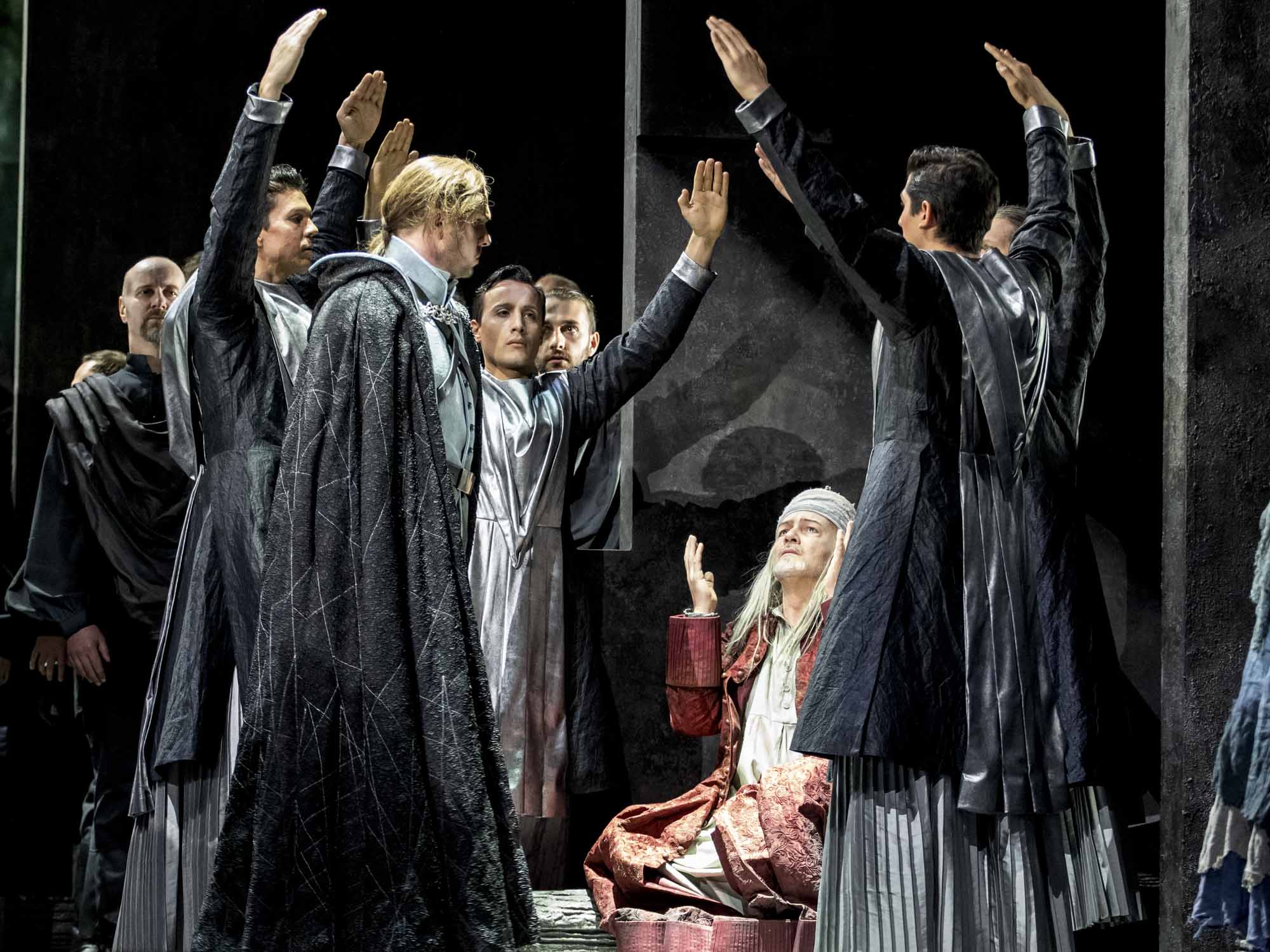
For the second year in a row, Richard Wagner’s stage festival Parsifal, directed by Jasmin Solfaghari and Stefan Hasler (eurythmy), was held during Holy Week at the Goetheanum in three sold-out performances. Impressions by Ronald Templeton. In September 1880, Richard Wagner wrote to his patron Ludwig II, King of Bavaria: “It was with a truly accurate sentiment that I titled Parsifal a ‘festival for the consecration of the stage’ [Bühnenweihfestspiel].” And because Wagner believed that art was “reserved to save…
18 April 2024 · 5 min
Nature experience · EN
Is Steiner Original?
Individuals are interwoven with the events of the outside world. How we want to deal with this is entirely up to us. This requires an inner perception. We have influence, even on the ideas themselves, and thus also on history. I am often confronted with the claim that Steiner could not possibly have had an original spiritual experience: he would have drawn his wisdom from a broad wealth of handed down wisdom teachings. For the most part, traditional historians assume…
08 June 2023 · 3 min

Forum · EN
Thanks
If you are looking to express gratitude in English, a superficial ‹thanks› quickly comes to mind. If you are being sincere, you say «thank you», always addressing the other person, or one step further, «I am grateful». It comes from the Latin word «gratias,» in turn leading back to ‹grate›: ‹pleasant,› ‹comforting.› Tracing it back even further in a linguistic sense leads to the Indo-European word ‹gwere›, which means ‹inclined,› ‹pleasing,› ‹benevolent.› So, in order to avoid superficiality and express…
03 June 2022 · 1 min

History · EN
Christian Rosenkreuz in the Orient
An attempt to synthesize from the research on his journey to the oriental spiritual centers of the 14th and 15th century. My basis goes back to the two Rosicrucian writings, the ‹Fama Fraternitatis› (Fama) and the ‹Confessio Fraternitatis› (Confessio), which Johann Valentin Andreae preceded the publication of the ‹Chymic Wedding› in 1516. Rudolf Steiner says of Andreae: «A very young person gives his hand to a spiritual entity that writes down something like the Chymic Wedding.» He also calls the…
18 March 2022 · 14 min