“As long as one doesn’t see their own part in a wound, the healing power cannot come.” Joachim Eckl said this to me recently in a conversation about the reignited conflict in the Middle East. This is a common wound that Palestine and Israel are inflicting upon one another, and we, too, are involved when we condemn people rather than actions. Both peoples are united in their wound and in their pain. Recognizing the common nature of the wound can bring about a change of perspective. As long as we are still trying to decide whose wound and whose fault is the greater, we legitimize violence, revenge, and retribution, and no healing can come. Perhaps the greatest frailty of human beings is not finding or having a home, not having a place where we are wanted. But, when I conceal my vulnerability in order to protect myself, then the opposite of healing happens: I re-enact the wound again and again. But how can the wound itself contain the potential to heal? What would that look like? What can arise when we show our vulnerability and so try to work with it? We can only begin to sense the answer: an ailing heart that feels the suffering of others—“The Promised Land.”
Translation Joshua Kelberman
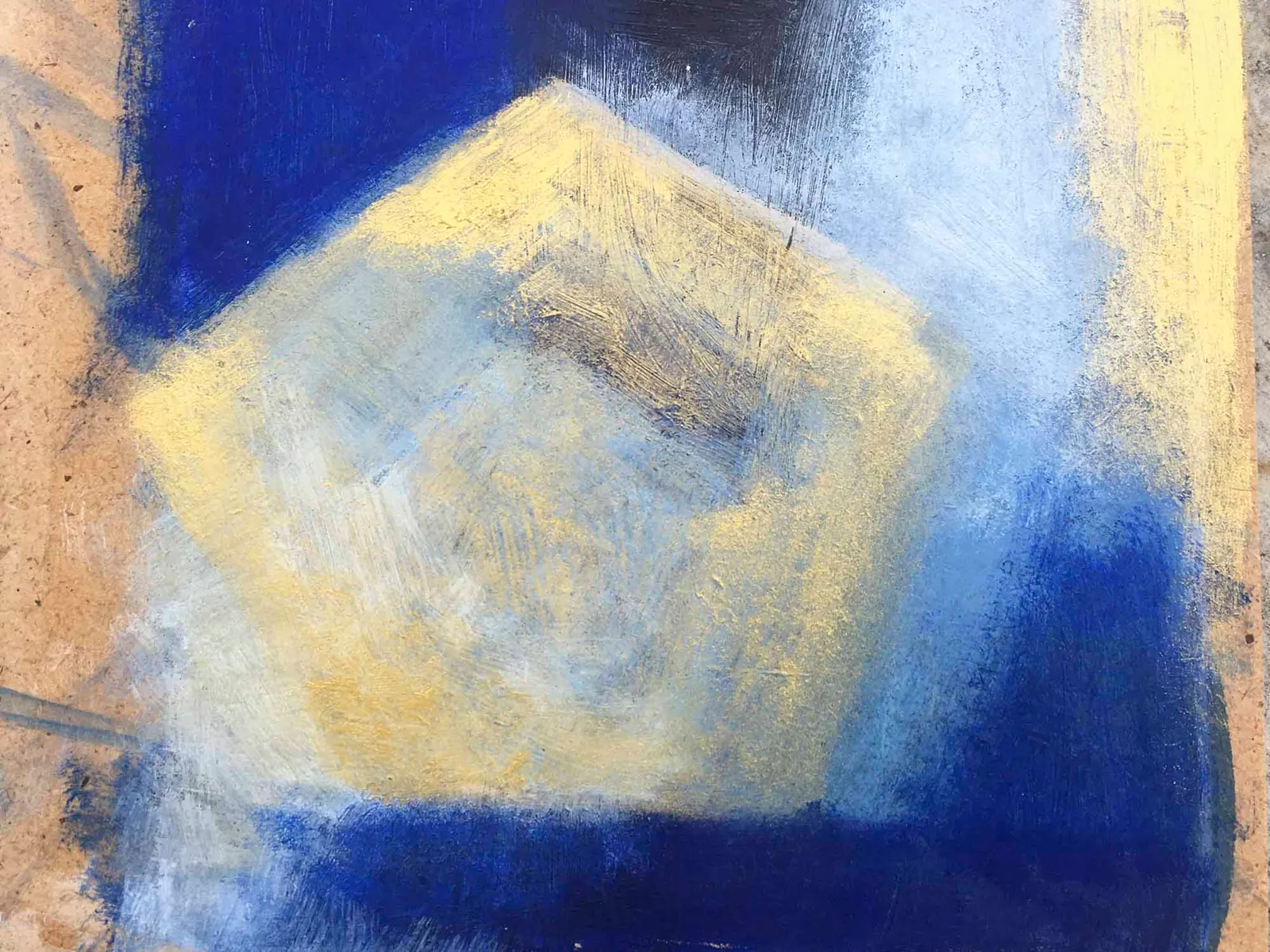
Image Christiane Haid, ‹Grundstein›, acrylic on hardboard, 2018.

Gilda Bartel ist Religionswissenschaftlerin, Ethnologin und Waldorflehrerin, arbeitet freiberuflich als Redakteurin, Autorin, Reiseleiterin, Lehrerin und Sozialarbeiterin. Sie ist Mutter zweier Söhne und lebt in Weimar.