The fairy tale in this issue speaks of three brothers: “Faith,” “Love,” and “Hope.” Where do these names come from? The search for clues leads to Paul’s “Song of Songs.” He was the first to characterize these three Christian virtues.
The fairy tale in this issue13 speaks of three brothers: “Faith,” “Love,” and “Hope.” Where do these names come from? The search for clues leads to Paul’s “Song of Songs.” He was the first to characterize these three Christian virtues. From Paul, the path leads back to Plato. The three Christian virtues were considered to be heaven’s answer to the four human virtues described by Plato in the Politeia: justice (dikaiosýne), prudence (sophrosýne), fortitude (andreia) and wisdom (phronesis or sophia). It is not difficult to find us humans in these four: justice is a matter of the body, prudence is a matter of life, fortitude is a matter of the soul, and wisdom is a matter of the mind.
Continuing along this path—where is the mythical source for Plato’s four virtues? Probably in Aeschylus. In his play Seven Against Thebes, one of the seven heroes is the childhood friend and seer Amphiaraos, who travels with six other friends to Thebes to liberate the city for his friend, King Polynices. Aeschylus attributes four virtues to Amphiaraos: he is intelligent, just, pious, and brave. Just as these virtues run through world literature, Aeschylus’ story also appears in a modern cinematic guise: The Seven Samurai by filmmaker Akira Kurosawa or The Magnificent Seven by John Sturges.
The story is always about dispelling an injustice through an alliance of seven, and it always succeeds because the seven, different as they are, unite. Community triumphs in diversity—that has been the message since Aeschylus. The Austrian writer Michael Köhlmeier advises us to look less at the battle that takes place and more at how the seven find each other. When it comes to virtue, the myth suggests two things: it locates its origin in the childhood friend and seer, and its development in the diversity of us humans. Virtue springs from seeing and triumphs from human diversity.
Translation Laura Liska
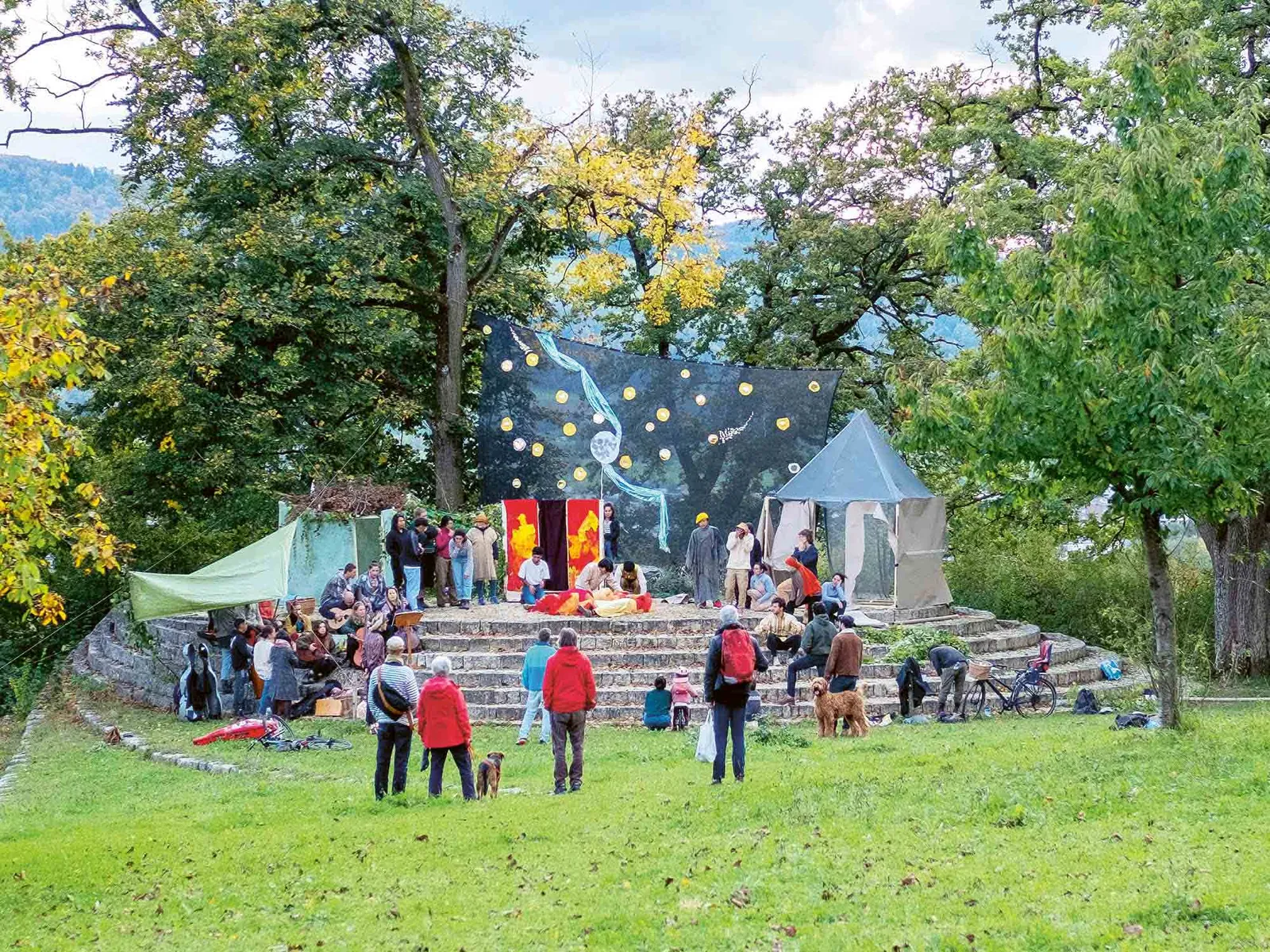
Image Rehearsals of the theater project Frage! Begegne! Spiele! [Question! Encounter! Play!] Photo: Mahdi Hosseingholi

Chefredakteur der Wochenschrift «Das Goetheanum», studierte Waldorfpädagogik und Mathematik. Er publiziert zu Lebensfragen, ist Autor des Sternkalenders, führt Studienreisen und ist Dramaturg an der Goetheanum-Bühne. Er hat drei erwachsene Töchter.