Section

Literary Arts

← Art

110 articles

Noli me Tangere

Noli me Tangere

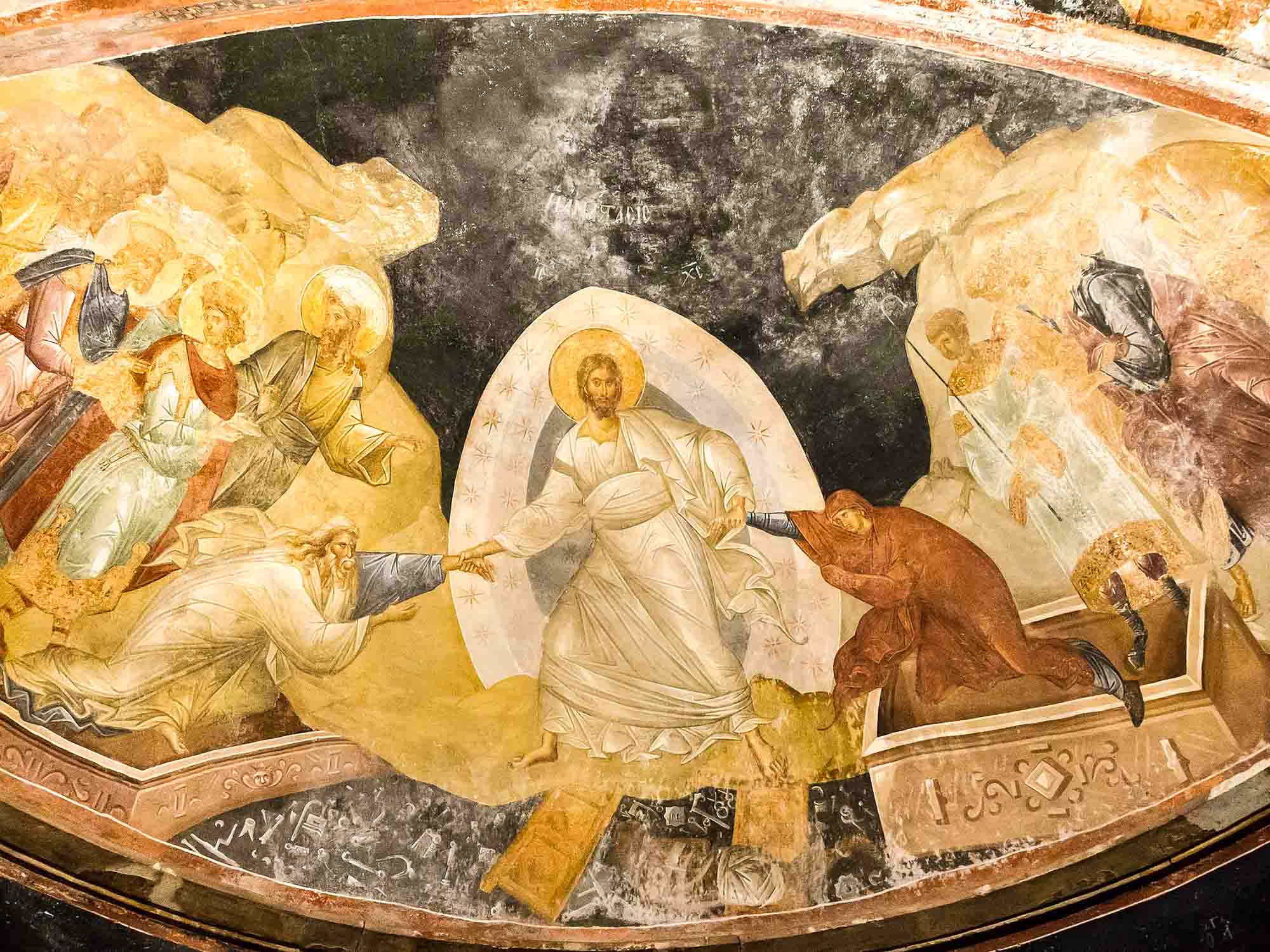
Christ appears twice at Easter: first to the dead, then to Mary Magdalene; first at night, then during the day; hidden in the apocryphal texts and revealed in the Gospels. Experiencing Easter means taking both appearances together, it means putting the Easter Vigil alongside Easter morning. During a stay in Instanbul in 2015, I visited the Chora Church in the Edirnekapi district on my last day. This church, on the foundations of an old monastery church, was decorated between 1316…

Walter Schafarschik · 05 April 2023 · 16 min

Our Relationship to Nature

Our Relationship to Nature

Our relationship to nature is largely determined by the imaginary world in which we live and by the direction in which we – unfortunately still mostly automatically – direct our consciousness. Usually, we experience ourselves surrounded by a world of objects, which could be there without us, as they appear in our consciousness. We believe we see objects outside of ourselves and don’t notice that – for them to appear to us in this way – we must imagine them…

Jochen Bockemühl · 30 March 2023 · 1 min

The Spear Comes Back

The Spear Comes Back

«Who is the Grail?» asks Parsifal. «There’s no telling,» replies Gurnemanz – describing the path to it: «Time becomes space here.» In this time that has become space, Richard Wagner opens a variety of windows on the Grail quest throughout his opera. Without revealing himself on the way, Gurnemanz leads the way through the events. Klingsor wants so badly to be accepted into the community of Grail knights, however, when he experiences rejection, he becomes the antagonist. Amfortas, the Grail…

Stefan Hasler · 30 March 2023 · 1 min

The Heart in the Gospels

The Heart in the Gospels

In all four of the gospels – but especially in Luke – the organ of the heart plays an essential, if not central role. The humanistic points of view, or rather the presuppositions of the corresponding gospel passages, are multilayered and distinctly differentiated in themselves; an overview of the totality – and an intensive effort for each individual heart-word – leads further and opens great, astonishing horizons. According to all the Gospels, the heart is an organ of compassion, of…

Peter Selg · 23 March 2023 · 2 min

Who Am I?

Who Am I?

Who am I? It’s a simple question, but one that is difficult to answer. I am myself and remain myself – even if some of my possessions are taken away from me – because I have them; however, I am not them. And what about important experiences that I’ve had and that I don’t want to miss because they’ve become a part of my personality? They’re not an interchangeable possession. My father, who twice experienced the devaluation of his money,…

Johannes W. Schneider · 10 March 2023 · 1 min

Why Images are Becoming Important

Why Images are Becoming Important

Throughout the Middle Ages, we can find the image of a dove flying into the ear of evangelists to inspire them. The being ‹behind› the people was decisive – impressively manifested in the pharaoh’s statue of Khafre, behind whose head the Horus falcon is placed. With the development of central perspective, telescopes and scientific experimentation, perception has turned to the world in front of our eyes; visual experience has become the origin of the perception of reality. What we see…

Andre Bartoniczek · 02 March 2023 · 1 min

How to Educate the Will?

How to Educate the Will?

Especially with regards to the will, it is important to see to exactly what extent the will can be educated at all. In the Act of the Consecration of Man, it is said that good will springs from a feeling that unites itself with Christ. This is in accordance with all the research in modern psychology: the will can only be summoned via a detour through feeling. Will cannot simply be pumped out of the human being. However, to stay…

Friedrich Rittelmeyer · 16 February 2023 · 1 min

Where the Spirit Resides

Where the Spirit Resides

The spirit doesn’t reside in the head, nor does it do so in the pineal gland, or in the neocortex. In the latter, only the consciously appearing, poor copy of the spirit is delivered in the form of conceptions, systems, models, diagrams, constructions, etc. The real, effective spirit, lies in the limbs. It is not my reflection that is spiritual, but my taking action, and realising in practice what others need. It is about discovering the esotericism of the deed.…

Wolfgang Schad · 10 February 2023 · 1 min

Life is the Key to Now

Life is the Key to Now

Life is always designed. It is always a present form that changes in time. In general, we perceive these phenomena as living, to which we grant a relationship to space and time, even if not entirely transparent, but always ordered. And such a relationship is always present in living beings. Spanish philosopher José Ortega y Gasset (1883-1955) once said: «Life means as much as the present.» There is no life that is not a permanently active present. In the inanimate…

Wolfgang Schad · 10 February 2023 · 1 min

What Do I Mean by ‹Elemental Beings›?

What Do I Mean by ‹Elemental Beings›?

Elemental beings live on the threshold between the sensory and spiritual worlds. They belong to both dimensions, the sensual and the spiritual, because the sensual world appears through their activity. Entire earthly existence is based on their quiet, uninterrupted, and faithful work. As a large, diverse group of spiritual beings, they carry the entirety of the earth; they carry the space perceptible to us through time. As a group of beings, they are preservers of the earth, time, and space.…

Karsten Massei · 03 February 2023 · 1 min

What Do I Mean by ‹Higher Thoughts›?

What Do I Mean by ‹Higher Thoughts›?

It is part of the character of thoughts relating to the supernatural that they can and should link the most powerful feelings with cognition. In short, one can say: spiritual knowledge transforms the one who knows. However, this also applies the other way around: only by developing oneself can one gain specific insights. This is especially true for those who want to train the organs of spiritual knowledge. Rudolf Steiner describes two fundamental conditions for students of the mind as…

Robin Schmidt und Heinz Zimmermann und Robin Schmidt · 20 January 2023 · 1 min

What Do I Mean by Dogmatism?

What Do I Mean by Dogmatism?

Some of its critics dismiss anthroposophical pedagogy as unscientific, e.g., because it attributes pre-existence – reincarnation – to individuals (Prange 1985, p. 20 ff.) or because it allegedly drew these views «from the traditions of the religious wisdom of the East […]» (Ulrich 1986, p. 94). However, it is not asked or even examined whether there are facts or laws that point to pre-existence (and reincarnation). From the outset, what these critics regard as science becomes their sole evaluation measure.…

Ernst-Michael Kranich · 05 January 2023 · 1 min